Common area fee and sinking fund in Thailand: what condo upkeep really costs

The price on the listing sheet is not yet the full purchase budget. After booking or at handover, a buyer may see additional lines: common area fee, sinking fund, meter connections, registration charges, furniture and other costs.
Two payments that are especially important not to confuse are the common area fee and the sinking fund. The first usually covers the day-to-day upkeep of the complex, the second builds a reserve for major future works.
Below we break down how they differ, how to check the developer's calculation, and why a large set of amenities affects not only a project's appeal but also the owner's expenses.
In short: the common area fee is a regular charge for operating the common areas. The sinking fund is a reserve fund for capital and unexpected expenses. Rates, payment terms and rules for using the money must be verified against the documents of the specific condominium.
💬 Want to check the numbers for a specific project? Send us the price list — we'll go through the charges and calculate the full budget. Message Evgenia on WhatsApp.
What is the common area fee
The common area fee is a regular payment by owners for the management and operation of the condominium's common property.
Depending on the project, it may include:
- security and CCTV;
- cleaning of common areas;
- pool and gym maintenance;
- garden and landscape care;
- reception and management staff;
- maintenance of lifts, pumps and engineering systems;
- electricity and water in common areas;
- garbage collection;
- minor routine repairs;
- a beach shuttle, if the complex budget provides for one.
The service set is not identical across projects. For example, a shuttle, parking or individual services may be charged separately. So a rate per square metre alone is not enough — ask for the list of what it covers.
How the common area fee is calculated
In Thai new builds this charge is often quoted as a rate in baht per square metre per month. The basic formula:
Unit area × rate per m² × number of months
Worked example
Suppose:
- unit area — 35 m²;
- rate — ฿60 per m² per month;
- at handover, 24 months must be paid upfront.
One year:
35 × 60 × 12 = ฿25,200
Two years upfront:
35 × 60 × 24 = ฿50,400
This is a conditional example, not an average or mandatory rate for Thailand. In a specific complex the calculation may depend on the registered unit area, the share in common property or the cost-allocation rules fixed in the condominium documents.
What is the sinking fund
The sinking fund is the condominium's reserve fund. Its purpose is to finance major works that are not part of ordinary monthly spending.
The fund may be used for:
- facade and roof repairs;
- replacement of lift or pump equipment;
- pool renovation;
- drainage and water-treatment system repairs;
- restoration of common areas;
- remediation of serious damage;
- other capital works approved under the established procedure.
In a new build, the initial sinking-fund contribution is often calculated by area and paid at handover. However, you should not automatically assume that no further levies will ever follow the first payment. If the reserve falls short, further funding will depend on the law, the registered condominium rules and decisions of the co-owners' general meeting.
Worked example — sinking fund
If the unit is 35 m² and the rate is ฿600 per m², the initial contribution is:
35 × 600 = ฿21,000
Common area fee vs sinking fund: what's the difference
| Parameter | Common area fee | Sinking fund |
|---|---|---|
| Purpose | Day-to-day operation of common areas | Reserve for major and capital works |
| Frequency | Regular; upfront payment possible in new builds | Often an initial contribution at handover, further decisions possible |
| Typical calculation | Rate per m² per month | One-off rate per m² |
| Example expenses | Security, cleaning, pool, lifts, staff | Facade, equipment, major repairs |
| Where to verify | Price list, contract, condominium rules, budget | Price list, contract, rules, meeting decisions, financial statements |
The buyer's main mistake is treating the sinking fund as a replacement for the common area fee. These are different funds with different purposes.
How much to add to the unit price: a full example
Take the 35 m² unit from the examples above:
| Payment | Calculation | Amount |
|---|---|---|
| Common area fee for 24 months | 35 × ฿60 × 24 | ฿50,400 |
| Sinking fund | 35 × ฿600 | ฿21,000 |
| Total at handover | ฿71,400 |
So the buyer needs ฿71,400 on top of the unit price for these two lines alone.
The full budget may also include:
- transfer registration fee;
- a Foreign Freehold surcharge, if provided;
- electricity and water meter installation;
- furniture and appliances not included in the fit-out;
- legal due diligence;
- bank fees and currency conversion;
- insurance;
- management and rental-preparation costs.
The composition and allocation of these payments are determined by the documents of the specific deal. You cannot carry a calculation from one project to another, even for units of identical size and price.
📐 Afraid of missing hidden handover charges? Fill in a short request — we'll send a verification checklist and calculate your unit's budget. Message Evgenia on WhatsApp.
How the common area fee affects the return on an investment unit
The common area fee is an owner's expense, so it must be counted in the net — not the advertised — return.
Suppose a unit generates ฿420,000 in gross annual income. From that the owner pays:
- common area fee — ฿25,200;
- management — under the contract with the management company;
- utilities, if not passed on to the tenant;
- repairs, appliance replacement and consumables;
- taxes and other applicable charges.
Gross income is not profit until expenses are deducted. And a promise that the tenant will fully cover the common area fee is not a fact but an assumption: it depends on the rental format, the contract terms and the market rate.
Why a low fee is not always an advantage
A low common area fee looks attractive but says nothing by itself about management quality.
A budget that is too small may not cover:
- timely repairs;
- enough staff;
- quality cleaning;
- pool and engineering maintenance;
- the complex's appearance.
Conversely, a high rate does not guarantee good service. What matters is not only the amount but the budget, financial statements, other owners' arrears, the state of the reserve fund and the actual quality of management.
For a completed complex, inspect the common areas and request the documents. For a project under construction, compare the promised amenities with the likely budget for running them.
Who pays for unsold units
Under Section 18 of the Condominium Act, joint expenses are borne by co-owners, and the owner of not-yet-transferred units also contributes to the expenses of those units. For a new project this matters: the unsold remainder must not automatically be shifted onto early buyers.
In practice, still check before purchase how this is reflected in the budget and rules of the specific complex.
Can the common area fee be raised or extra money collected
The size of advance charges, the procedure for managing common property and the allocation of payments must be reflected in the condominium rules. Changes to the registered rules are adopted by the general meeting and registered under the established procedure. Section 40 of the Condominium Act also provides for contributions to the fund and other sums to implement general-meeting decisions.
So the rate from the original price list is not necessarily fixed for the whole period of ownership. Charges can be revised if service prices rise, the scope of services changes or major repairs are needed.
What happens if you don't pay the common area fee
Arrears on common charges are not merely an internal matter for the management company. The law provides for a late-payment surcharge, and prolonged arrears may bring further restrictions under the condominium rules. For a later resale, the condominium juristic person's certificate of no arrears is required to register the transfer. These provisions are in Sections 18/1 and 29 of the Condominium Act.
A buyer on the secondary market should request this certificate and clarify who settles any existing debt before the deal.
What to check before booking a unit in a new build
Ask the seller or agent for written answers to the following questions:
- What is the common area fee rate, and in what units is it quoted?
- Which area is used in the calculation?
- How many months or years are paid upfront?
- From what moment does the charge accrue: handover, title registration or another date?
- What exactly does the common area fee include?
- Is there a separate charge for shuttle, parking, internet or extra services?
- What is the initial sinking fund amount?
- Are further levies possible, and who approves them?
- Who pays the expenses of unsold units?
- Which document prevails if the price list and the contract diverge?
All material figures must appear not only in correspondence or a presentation but in the deal documents.
What to check when buying on the secondary market
A completed condominium already has an operating history, so you can assess real figures rather than promises.
It is worth requesting:
- the current common area fee rate;
- a certificate of no arrears on the unit;
- the registered condominium rules;
- the latest financial statements and budget;
- the reserve fund balance;
- minutes of recent owners' meetings;
- information on planned repairs;
- data on special levies and litigation;
- the actual condition of pools, lifts, facades and engineering systems.
A large sinking fund on paper does not guarantee financial soundness. Understand which obligations are already planned and how transparent the reporting is.
A beautiful pool: asset or expense?
Both.
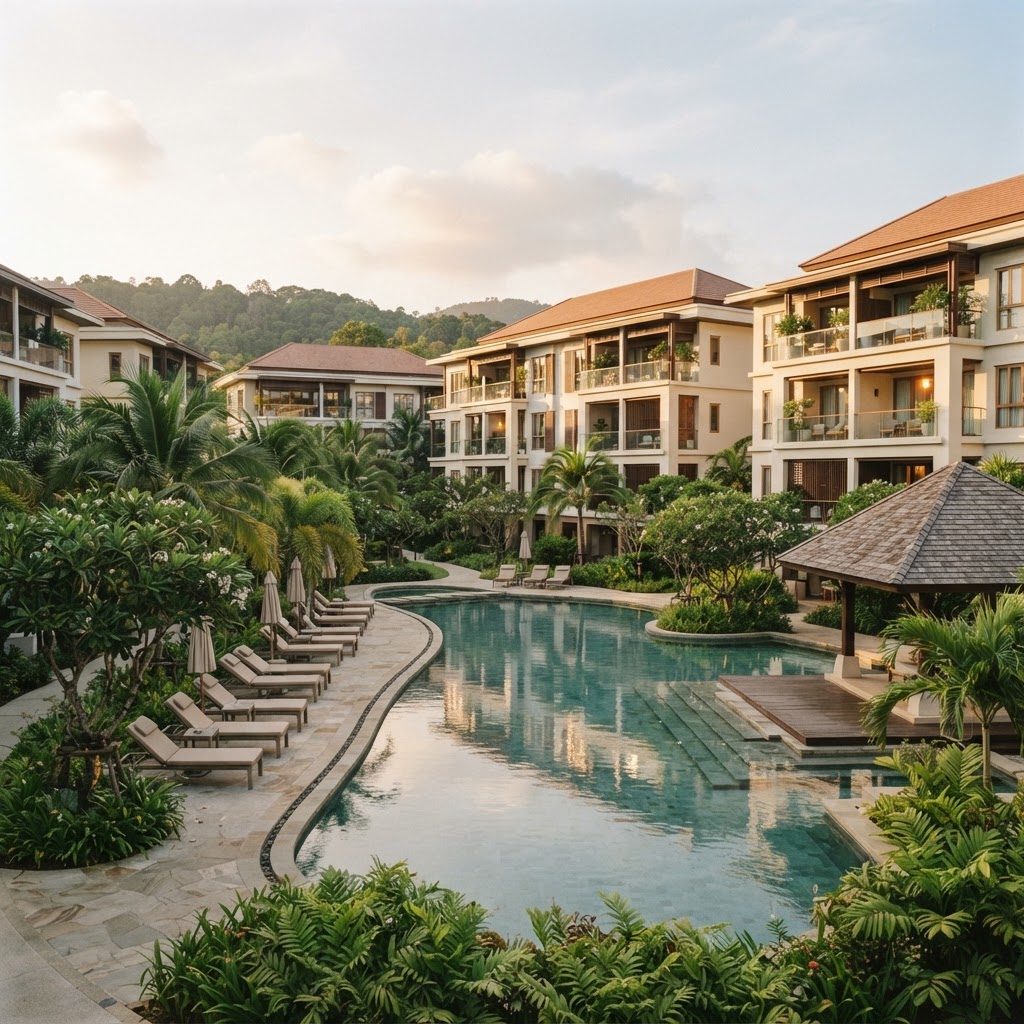
Quality infrastructure can raise a complex's appeal for residents and tenants. But every pool, garden, shuttle and extra zone requires staff, electricity, water, repairs and regular maintenance.
So compare two projects not by the number of objects in the render but by the combination of four factors:
- how much the infrastructure is needed by the target audience;
- what it costs to maintain;
- whether the budget matches the scale of the complex;
- whether the future rental rate can cover the costs without inflated forecasts.
Jungle House takeaway
- Confirmed principle: owners share the costs of maintaining the condominium's common property.
- Project-specific terms: the common area fee rate, sinking fund size, prepayment period, list of included services and possible extra charges.
- Forecast: future occupancy, rent growth and the ability to offset costs through rent.
The price on the listing sheet answers how much the unit costs. But only a full calculation shows how much money is needed before you get the keys and during ownership.
Before booking, request not a single total but a detailed table of payments showing the basis, timing and recipient of each payment.
🔥 Before booking, have the developer's calculation checked for hidden charges. Send the price list or calculation — message Evgenia on WhatsApp — we'll go through the mandatory payments and calculate the full budget without marketing promises.
Browse the Thailand new-build catalogue
Sources and verification date
- Department of Lands Thailand, condominium Q&A: https://www.dol.go.th/en/question-answer/Q2601-000101
- Condominium Act B.E. 2522 (1979), amended translation: https://www.thaicondolaw.pingstone.com/files/4613/6314/6199/CONDOMINIUM_ACT.pdf
- Department of Lands Thailand, condominium section: https://www.dol.go.th/en/building/
Verified on September 30, 2026. This material is informational and does not replace legal review of the documents of a specific deal. The Thai version of the legislation has legal force; English translations are for reference only.
Want to discuss investments?
Write to us and we'll find properties to match your budget with an honest return calculation.