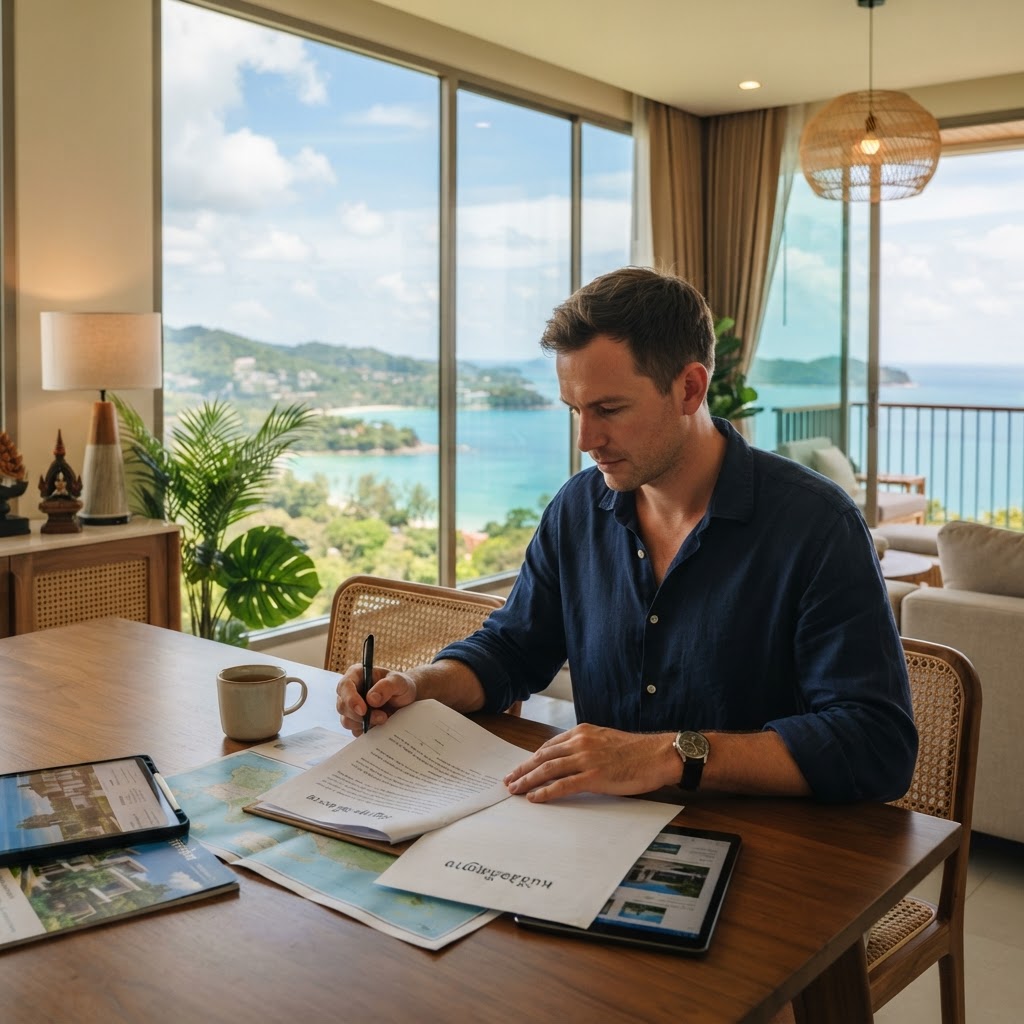
The 5 Documents We Want to See Before a Deposit for Property in Phuket


The most expensive mistake often happens not at the signing of the main contract.
But earlier.
When, after the showroom tour, the beautiful master plan and the yield discussion, the buyer says:
"I like it. Let's fix the unit."
Within minutes they may already be sent a payment link or bank details for a deposit. The amount seems small compared to the cost of a condo or villa, so the payment is easy to take as a technical formality.
But it is at this moment that the buyer takes on their first financial and negotiating dependency. The unit is off the market — at least, that is what the seller promises. The clock on the next payment has already started. And the return of the deposit may depend on the terms of a reservation agreement the buyer has not seen or has not had time to study.
That is why at Jungle House we want to receive the key documents before money is transferred, not at the point when walking away from the deal is already psychologically and financially harder.
Important: the composition of the package depends on the property. Checking a condo in a registered condominium, an off-plan condo, a leasehold villa and a property with hotel management are not the same procedure. Below are the five basic blocks we start with.
First: the reservation agreement and the deposit terms themselves
Before the five main documents, there is one more worth requesting: reservation form / booking agreement / deposit agreement.
It must clearly state:
- the exact property: project, building, floor, unit number, area and layout;
- the price and whether the deposit counts toward it;
- how long the unit is fixed;
- the date for signing the main contract and the schedule of further payments;
- cases when the deposit is returned or kept;
- what happens if legal due diligence reveals a material problem;
- who receives the money and whether that recipient matches the deal's counterparty;
- which language version of the document prevails.
For condos this is especially relevant: Thailand's Office of the Consumer Protection Board has classified the sale of apartments with reservations as regulated contractual activity and publishes a corresponding standard regime for reservation contracts. This does not mean any document you receive is automatically safe. It means the reservation stage is already a legally meaningful stage, not just "putting a unit on hold". Office of the Consumer Protection Board
📋 Get the document package for your property checked — on WhatsApp with Irina Korotkaya
1. Land documents: what exactly we check
A beautiful project begins not with a render, but with the land plot.
At a minimum we want to see a copy of the land document and match it to the project. Depending on the deal structure and construction stage, the check may include a current extract or a search at the Land Office, not just a scan sent by the seller.
We need to establish:
- who is the registered owner of the plot;
- whether the owner matches the selling company, or on what basis the developer uses the land;
- whether the plot number and location match the announced project;
- which type of land document is presented;
- whether there are registered mortgages, leases, easements and other encumbrances;
- whether the documentation secures legal access to the road and necessary utilities;
- whether the verified plot covers the entire promised master plan, including access roads, infrastructure and common areas.
If one company holds the land, another signs the contract and a third will manage the property, this does not necessarily mean a problem. But the links between them must be confirmed by documents, not explained by a single phrase from a manager.
Why a developer's logo alone is not enough
The project brand, the landowner, the SPA counterparty and the payment recipient can be different legal entities. So the question is not only "who is the developer?" but also:
Which company owns the land, which is obliged to build the property, and which is answerable to the buyer under the contract?
2. Permits: is what they sell actually allowed to be built
The master plan shows the concept. The permit documentation shows what has been approved for implementation.
In a basic check we look at:
- the construction permit and the applicant's details;
- whether the permit matches the plot and the announced buildings;
- approved plans regarding the building, number of floors and designation;
- construction status and applicable approvals;
- EIA and its status, if an environmental assessment is required for the specific project;
- for a future condominium — the structure and documents needed to later register the building as a condominium;
- for hotel operation — the legal basis of the hotel's operation and the entity that must obtain or holds the relevant licence.
Thailand operates an official system for reviewing construction permits under the Building Control Act, and the statuses of environmental reports can be searched in the state Smart EIA Plus database. A project appearing in the database does not equal final approval: what matters is reading the actual status and matching the project's parameters. Department of Public Works and Town & Country Planning and Smart EIA Plus
What we compare with the advertising
We match the documents with what influences the buyer's decision:
- the specific building and floor;
- the number of buildings;
- pools, parking, driveways and other common areas;
- the view from the window and neighbouring plots;
- the stated designation of the property;
- the project's phases;
- the promised hotel infrastructure.
If a property is sold at an early stage, some permits may still be in process. Then it is important not to present a future outcome as an already obtained document, and to explicitly record which risk the buyer is taking on.
🏗️ Request the list of permits for a specific project — on WhatsApp with Irina Korotkaya
3. SPA: what the main purchase contract actually says
SPA — Sale and Purchase Agreement — is the main purchase contract. It, not the presentation or the messenger chat, defines the parties' obligations.
Before a deposit it is desirable to receive at least the current draft SPA and its annexes. We pay particular attention to the following sections.
Subject of the contract
The unit number, building, floor, area, layout, finishing specification, furniture package and price must all match. If the actual area may change after completion, the contract must explain the permitted deviation and the recalculation.
Deadlines and payments
We need not only an indicative completion year, but the contractual date, the payment schedule, the conditions for extending the term and the consequences of delay.
Liability of the parties
We check sanctions not only for the buyer but for the seller: what happens if construction is delayed, the property cannot be handed over, or the project materially changes.
Termination and refunds
It is important to understand:
- in which cases the buyer can exit the deal;
- which amounts are withheld;
- within what period money is returned;
- what happens if ownership cannot be registered in the promised form;
- what happens if registration is refused or the agreed ownership structure cannot be obtained.
Changes to the project and specification
The wording "the developer may change the project" must not turn into a right to replace essential characteristics without clear limits and consequences for the buyer.
Assignment
If the purchase is considered as an investment before completion, we check the possibility of assignment: whether the developer's consent is required, whether there is a fee, a minimum paid percentage and time restrictions.
For condo sales, the Thai consumer protection authorities classify such contracts as regulated and specify mandatory content requirements. But individual verification is still needed: the commercial structure, annexes and specific risks differ between projects. Office of the Consumer Protection Board
4. How exactly ownership is formalised
The phrase "this is Freehold" by itself settles nothing.
The next question to ask:
Freehold of what exactly, and what right will be registered in the buyer's name?
If it is a condominium
A foreign buyer can register an ownership right over a specific unit in a condominium if the conditions of the law are met and the foreign quota is available. According to official explanations from the Department of Lands, total foreign ownership is limited to 49% of the total area of all units in the relevant condominium — it is area, not simply the number of apartments, that counts. At registration the buyer's grounds and documents on the arrival of funds are also checked. Department of Lands
So before payment it is important to understand:
- whether the property will be registered as a condominium;
- what exactly the contract promises: foreign freehold or another structure;
- whether the foreign quota is confirmed as available for the specific unit;
- what happens if the quota turns out to be unavailable at transfer;
- which bank documents will be required for registration.
If it is a villa or apartments outside a condominium
The word freehold may refer to the building, a share in a company or another element of a structure, but it does not necessarily mean direct ownership of land by a foreign individual.
The structure needs to be broken into parts:
- who owns the land;
- on what right the buyer uses the land;
- who owns the building;
- what will be registered at the Land Office;
- what is the term of the registered leasehold;
- which rights depend only on the contract and the counterparty's promises;
- how sale, inheritance and exit from the structure work.
If ownership is offered through a Thai company, the structure, the actual shareholders, management and compliance with restrictions for foreigners require a separate independent legal assessment. A formal scheme must not mask a nominee arrangement.
📄 Clarify what right will be registered in your name — on WhatsApp with Irina Korotkaya
5. The investment model: where the income promises are fixed
If a property is sold through a Rental Pool, hotel management, leaseback or "guaranteed income", a presentation is not enough. A separate contract or package of contracts is needed.
The document must define:
- the operator and the party answerable to the owner;
- the management term and renewal conditions;
- the rental start date and program launch conditions;
- what is the calculation base: gross revenue, revenue after platform commissions, operating profit or Net Profit;
- the full list of expenses before money is distributed;
- the formula of the specific owner's share;
- the composition of the Rental Pool and the rules for including or excluding units;
- the frequency of reporting and payouts;
- taxes and bank charges;
- owner stay: how many days, on which dates and at whose expense;
- the reserve for repairs, furniture and appliance replacement;
- the owner's right to audit the calculations;
- early exit terms;
- consequences of a change of operator or brand;
- security for the guarantee, if the income is called guaranteed.
"70/30" does not yet say anything about yield
The phrase "the owner receives 70%" does not answer the main question: 70% of what?
For example, OTA commissions, taxes, marketing, operating expenses, utilities, management and reserves may first be deducted from revenue. Only then is the remainder divided between the operator and the pool of owners. Then the pool's share is distributed by an internal formula.
So a marketing percentage cannot automatically be treated as the investor's net yield.
The universal verification formula looks like this:
Net yield = owner's net annual income ÷ total investment amount × 100%
The total investment amount includes not only the unit price but also mandatory payments, furniture, fees and other expenses needed to launch and own the property.
If the project will operate as a hotel, what is checked separately is not only the name of the international brand but the brand's contractual role, its coverage of the specific building and the licensing structure. The state Department of Provincial Administration runs the hotel licence procedure; a promise of future hotel operation should not be accepted as an already existing licence. Department of Provincial Administration
📊 Have the investment model and Rental Pool contract checked — on WhatsApp with Irina Korotkaya
A short pre-deposit checklist
Before money is transferred we want answers to ten questions:
- Which exact unit is being reserved, and for how long?
- Is the deposit returned if legal due diligence reveals a material risk?
- Who owns the land, and are there registered encumbrances?
- Which company signs the reservation agreement and the SPA?
- Which permits have already been obtained, and which are still in process?
- Does the building being sold match the permitted project?
- What specific right will be registered in the buyer's name?
- Is the foreign quota confirmed for this specific condo unit?
- Where are the promises on income, management and owner stay fixed?
- Who will return the money, and by what procedure, if the deal does not happen?
Red flags before payment
It is worth stopping and requesting explanations if:
- the deposit is offered to be paid "today" without showing the reservation agreement;
- the payment recipient is not explained and does not match the deal's counterparty;
- instead of a land document you are sent only a presentation;
- a request to show a permit is answered with a new render;
- the foreign quota is confirmed only by a manager's message;
- the contract is promised after payment;
- guaranteed income exists only in a booklet;
- important answers are given verbally and they refuse to include them in the contract;
- the buyer is rushed with the "last unit" argument but is not given time for checks.
One such sign does not always mean the project is bad. But it means the risk must be closed before payment.
Why a deposit is not a small formality
After the deposit, the buyer's position changes.
Before payment, they compare options and set conditions. After payment, they are already trying not to lose the chosen unit and the money paid. Even if the amount is relatively small, the sunk-cost effect kicks in: inconvenient questions get postponed, and disputable wordings get accepted, so as not to start the search over.
So the right sequence looks like this:
choose a property → receive documents → check the structure → agree the deposit terms → only then pay
Not every project can provide a final set of documents at an early stage. But the buyer must clearly see the boundary between what already exists and is confirmed, what is in process, and what so far remains a marketing promise.
FAQ
Can a project be fully checked before a deposit?
Not always. The scope of verification depends on the project's stage and the deal type. But before payment it is possible to determine which documents exist, who the parties are, what right is being sold, on what terms the deposit is returned, and which key risks remain open.
Is a letter from the developer about the foreign quota enough?
No, if we are talking about final confirmation of the right to register. The deal structure and applicable documents must be checked, and the contract must provide for what happens if the promised foreign freehold turns out unavailable. For a completed condominium, the juristic person documentation and the Land Office procedure matter; for off-plan, the developer's contractual obligations matter.
Are the SPA and the reservation agreement the same thing?
No. The reservation agreement fixes the booking and the deposit terms. The SPA governs the main transaction, payments, construction or transfer, liability and termination. Both documents require attention.
If the deposit is refundable, can you pay right away?
First read under what circumstances it is returned, who makes the decision, what proof is required and within what period the refund is made. The single word "refundable" is not enough.
Does document verification guarantee there is no risk?
No. It helps reveal the deal structure, contradictions and the distribution of risks, but it does not turn a property under construction or an investment forecast into a guaranteed result.
The Jungle House approach
We do not treat a deposit as a small formality.
Our job is to help the buyer understand not only whether they like the property, but what exactly they are buying, what right they receive, who is answerable under the contract, and what the investment model is based on.
If you are considering a condo, villa or Rental Pool property in Phuket, send us the project and the unit you have chosen. We will help draw up questions for the seller, check the deal's logic and separate documents from presentational promises.
Jungle House — property in Phuket on the buyer's side.
Go to the Jungle House website
✅ Send a project for a pre-deposit check — on WhatsApp with Irina Korotkaya
This material is informational and is not legal, tax or investment advice. The scope of verification depends on the property type, project stage, deal parties and the buyer's status. Before signing and paying, an independent verification of documents by a qualified lawyer in Thailand is recommended.
Get new articles in Telegram - follow the Jungle House Phuket channel
TelegramWant to discuss investments?
Write to us and we'll find properties to match your budget with an honest return calculation.