Apartment in Phuket for Vacation or Living: How to Choose

An apartment in Phuket for vacation and an apartment for living: why these are two completely different properties
"Which area of Phuket is the best?" is one of the most common questions property buyers ask.
But there's no universal answer to it.
An area can be wonderful for a two-week seaside vacation and completely inconvenient for everyday life with children. An apartment with an impressive view can be perfect for short visits but exhaust the owner with a difficult access road, no parking, and daily trips across the whole island.
So the right question sounds different:
"The best area — for what?"
Property selection in Phuket should start with defining the goal. Not from a photo of a pool, the name of a beach, or a promised yield, but from the real usage scenario of the property.
Two buyers — two different Phukets
Imagine two clients with the same budget.
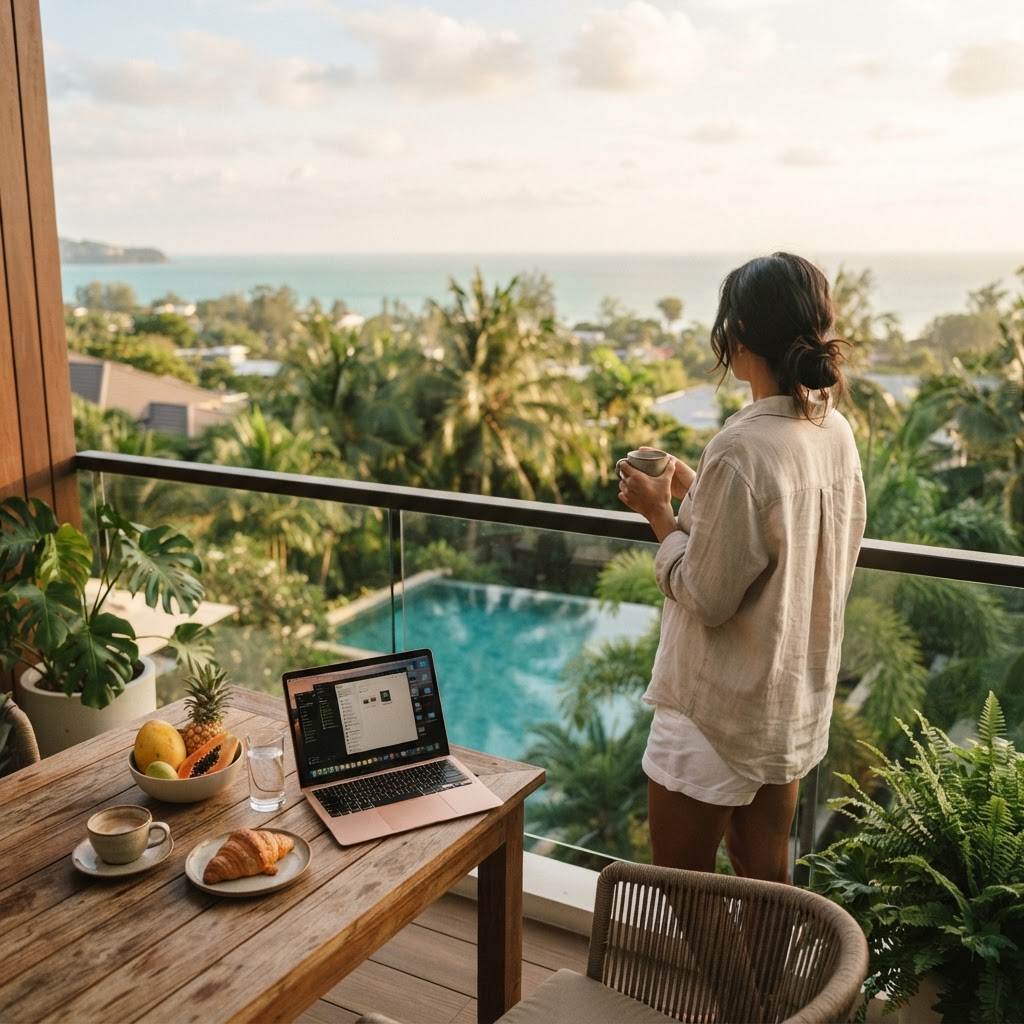
Client A: an apartment for vacation
They come to Phuket twice a year for two or three weeks. The rest of the time the apartment can be rented out or under management.
What matters most to them:
- proximity to the beach;
- restaurants and cafes nearby;
- a beautiful view;
- a pool, gym, and other resort infrastructure;
- the ability to start the vacation quickly, without solving household issues;
- professional management of the apartment in the owner's absence;
- clear terms for personal use and rental.
Such a buyer evaluates property as part of a vacation lifestyle. They want to step out of the apartment and, within minutes, be at the sea, in a restaurant, or by the pool.
Client B: an apartment for permanent living
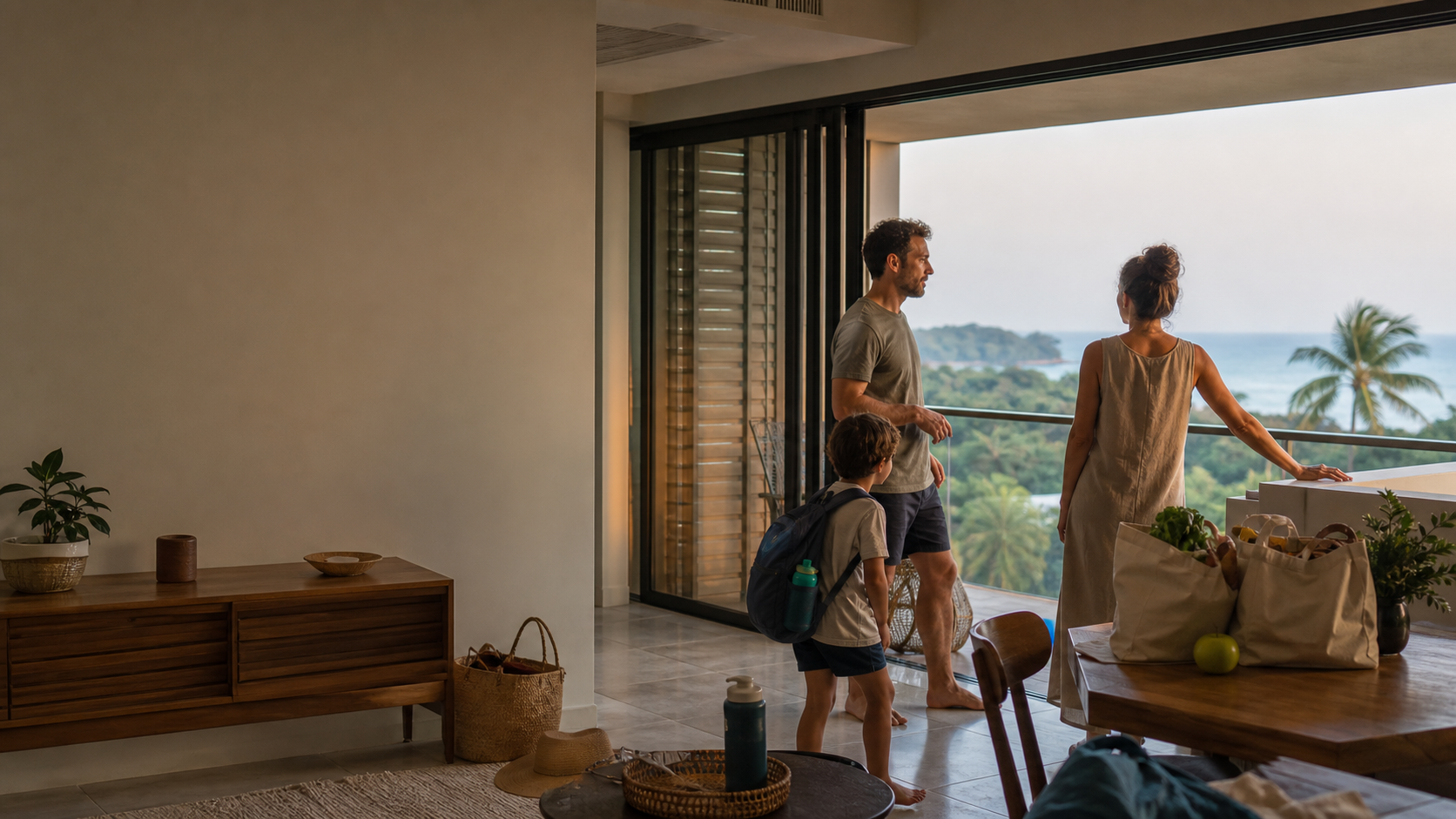
They're relocating to Phuket with family and plan to live here most of the year.
Their questions will be completely different:
- how long is the drive to school;
- is it convenient to commute to work every day;
- where are shops and the hospital;
- is there sport and children's infrastructure nearby;
- are there enough rooms and storage spaces;
- is there a full kitchen;
- is there parking;
- how convenient is it to enter the area during rush hours;
- can you comfortably live in the apartment during the rainy season;
- whether noise, tourist flow, and short-term rental of neighboring apartments are a disturbance.
For this client, an apartment is no longer a vacation backdrop but the space where everyday life will unfold.
That's exactly why a property that's perfect for Client A can turn out to be a poor choice for Client B — even at the same price and in the same area.
How a vacation apartment differs from a living apartment
| Criterion | Vacation apartment | Living apartment |
|---|---|---|
| Main goal | Recreation and possible rental | Comfortable daily living |
| Location | Beach and tourist infrastructure | School, work, shops, healthcare |
| Layout | Can be compact | Area, rooms, and storage matter |
| View | Often one of the main criteria | Important, but not always a priority |
| Project infrastructure | Pool, gym, restaurant, service | Parking, security, everyday convenience |
| Transport | Convenience of short trips | Daily routes and road congestion |
| Management | Critical in the owner's absence | Can be secondary |
| Surroundings | Resort atmosphere | A comfortable year-round environment |
| Economics | Costs, rental, vacancy, personal use | Monthly costs and quality of life |
This doesn't mean one apartment can't be used both for vacations and for permanent living. But finding a truly universal property is harder. Almost always you have to set priorities and make conscious compromises.
How to choose a vacation apartment in Phuket
1. Count real time, not distance
The phrase "five minutes to the beach" says little on its own.
It's important to find out:
- whether you can walk to the sea;
- whether the route is safe;
- whether there are inclines and busy roads;
- whether you'll need a car;
- how long the trip takes during peak load;
- whether convenient transfer is available.
On the map, a property may look close to the beach, but the real route turns out significantly longer or harder.
2. Evaluate the vacation infrastructure around
If the owner comes only for a few weeks, they usually don't want to spend the vacation solving household issues.
So an advantage can be:
- restaurants and coffee shops nearby;
- a supermarket or grocery delivery;
- massage, spa, and fitness;
- beach clubs and recreation spots;
- vehicle rental;
- a reception or concierge service.
Here it's important to assess not the number of places on the map but how easy they are to use every day.
3. Check who will handle the apartment in the owner's absence
Buying a resort apartment doesn't end with handing over the keys.
Someone has to:
- monitor the condition of the property;
- pay the bills;
- organize cleaning and repairs;
- meet tenants;
- look after equipping;
- report to the owner;
- handle emergencies.
If the developer or the management company offers a rental program, you need to separately check the contract terms: the list of costs, the commission, the rules for personal use, the payout procedure, and the possibility of exiting the program.
The mere presence of a management company doesn't guarantee either occupancy or a specific yield.
4. Count the total cost of ownership
Besides the apartment price, the owner may face regular and one-off costs:
- common property maintenance;
- utility payments;
- internet;
- insurance;
- cleaning;
- repair and furniture renewal;
- management services;
- costs related to renting out;
- mandatory payments under the specific project's terms.
All amounts and obligations must be checked against the documents of the chosen property. A beautiful resort complex can be comfortable for a vacation but expensive to maintain.
👉 Choose a vacation apartment with Irina Korotkaya on WhatsApp
How to choose an apartment in Phuket for permanent living
1. Start with the daily route
For a family, the main point on the map isn't always the beach.
It's much more important to understand where you'll have to drive almost every day:
- school or kindergarten;
- work;
- sports classes;
- a supermarket;
- the hospital;
- meetings and everyday errands.
If the school is on one side of the island and the apartment on the other, an attractive view from the window is unlikely to compensate for several difficult trips every day.
Before buying, it's useful to drive the future routes in the morning, at midday, and in the evening, rather than relying only on the navigator during a viewing.
2. Check the layout, not just the area
Two apartments of the same area can suit a family very differently.
You need to look at:
- whether the bedrooms are separate;
- whether there's a full kitchen;
- whether there's room for a dining table;
- where to put a desk;
- where to store suitcases, sports gear, and household items;
- whether there's a utility area;
- whether there's enough natural light;
- whether the rooms can be aired out;
- whether the balcony is comfortable to use in different weather.
A compact resort layout can look striking in renders but be inconvenient for permanent everyday life.
3. Evaluate parking and access
For a short vacation, limited parking can seem like a minor detail. With permanent living, it quickly becomes a daily problem.
It's worth finding out in advance:
- whether a space is assigned to the apartment;
- how many parking spaces the complex provides;
- where the second car or guests' vehicles are left;
- whether it's convenient to enter the grounds;
- whether the access floods during heavy rain;
- whether there's a safe exit onto the main road.
4. Look at the life of the complex, not just its amenities
A big pool and a beautiful lobby don't always mean comfortable permanent living.
For a family, these can matter more:
- quiet at night;
- access control;
- working elevators;
- stable maintenance;
- a children's area;
- the absence of a constant turnover of noisy tourist groups;
- clear rules for residents;
- adequate management company work.
You need to understand who the complex is designed for: tourists, short-term rental, seasonal owners, or permanent residents.
👉 Choose a family living apartment with Irina Korotkaya on WhatsApp
Why you can't choose "the best area of Phuket" by rating
Phuket can't be evaluated on the principle of "first, second, and third place."
One area can be convenient thanks to resort infrastructure and proximity to the beach. Another thanks to access to schools, shops, and main routes. A third will suit a buyer looking for a calmer environment and ready to use a car more often.
Each option will have its own compromises:
- close to the beach, but far from the school;
- quiet, but no restaurants within walking distance;
- developed infrastructure, but denser traffic;
- a beautiful view, but a difficult access road;
- a spacious apartment, but without professional management;
- a full resort, but with a high share of short-term guests.
So the area should be chosen not by popularity but by how well it matches the buyer's personal scenario.
One apartment for living, vacation, and rental: is it possible
Yes, but first you need to determine which function will be the main one.
For example:
- if a family lives in Phuket ten months a year, everyday convenience should matter more than the apartment's potential appeal to tourists;
- if the owner comes a few times a year and plans to rent the property the rest of the time, location, management, and the rental program terms become more important;
- if the apartment is being bought for a future relocation, you need to check that you won't have to change it in two years because of an inconvenient layout or location.
Trying to find a property that will be the best on all criteria at once often leads either to an inflated budget or to non-obvious compromises.
A working approach is to define three to five mandatory conditions and separately make a list of characteristics the buyer is willing to sacrifice.
Three levels of proper property selection
Level 1. Scenario
First we determine:
- who will use the apartment;
- how many months a year;
- whether the property will be rented;
- whether a relocation is planned;
- whether there are children;
- what the daily routes will be;
- whether a car is needed;
- what costs are acceptable.
Level 2. Area
After that we compare areas by specific criteria:
- access to the places you need;
- transport;
- surrounding infrastructure;
- the character of development;
- tourist load;
- seasonal features;
- plans for the development of the surroundings.
Level 3. Project and apartment
Only then does it make sense to choose a specific complex and unit:
- layout;
- floor;
- view;
- window orientation;
- noise level;
- construction quality;
- management;
- maintenance costs;
- the legal structure of the deal;
- terms for personal use and rental.
If you start right at the third level, it's easy to fall in love with a beautiful property that doesn't solve the buyer's real task.
Questions worth answering before the search begins
Before selecting a property, formulate answers to at least the following questions:
- How many weeks or months a year do you plan to be in Phuket?
- Who will live in the apartment?
- Are there children, and which school will they be tied to?
- What trips will you have to make daily?
- Is walking access to the beach needed?
- Is renting the apartment planned?
- Who will manage the property in your absence?
- How many bedrooms and storage spaces are needed?
- Is a full kitchen needed?
- How many cars will the family have?
- What annual maintenance costs are acceptable?
- Which three requirements are mandatory, and which can you give up?
The more precise the answers, the fewer random options in the selection.
Typical buyer mistakes
Choosing only by a beautiful view
A view matters, especially for vacation property. But it won't fix an inconvenient layout, noise, a difficult access road, or constant trips across the island.
Assuming proximity to the beach solves everything
For a tourist — sometimes yes. For a family, the drive to school, a shop, or work can matter more.
Buying a small apartment "for starters"
After a relocation, it quickly turns out there isn't enough of a second bedroom, workspace, kitchen, or storage. Resale and moving will take extra time and money.
Not checking the management and rental rules
A marketing presentation is no substitute for a contract. The terms of personal use, income distribution, costs, and exit from the program must be studied before buying.
Evaluating the area only during a viewing
An area can feel different during the day and in the evening. It's useful to come at rush hour, on a weekend, and, if possible, in different seasons.
How we start property selection at Jungle House
We don't start selection with the question: "Which project should I show you?"
First we find out:
- why you need property in Phuket;
- how exactly you'll use it;
- who will live in the apartment;
- what routes will become daily;
- whether you plan to rent the property;
- which criteria are mandatory;
- what compromises you're ready for.
And only after that we compare areas, projects, and specific apartments.
This approach helps not just to buy an attractive property, but to choose one that truly matches your lifestyle.
Don't ask: "Which area of Phuket is the best?"
Ask:
"Which area is better for my specific task?"
Tell us whether you plan to come for vacations, relocate with family, or combine personal use with renting out the apartment. We'll pick options for your scenario, budget, and real priorities.
👉 Get an apartment selection for your scenario from Irina Korotkaya on WhatsApp
Frequently asked questions
Which area of Phuket is best for permanent living?
It depends on the location of the school, work, shops, hospital, and other places you visit regularly. There's no universally best area for all families.
Where is it better to buy an apartment for a vacation?
Usually convenient access to the beach, restaurants, services, and resort infrastructure matters. But additionally you need to check the maintenance and management costs of the apartment in the owner's absence.
Can you live permanently in a resort complex?
You can, if the layout, parking, noise level, complex rules, and surrounding infrastructure suit everyday life. A pool and a gym by themselves don't guarantee that.
How to combine personal use and renting out the apartment?
You need to define the periods of personal use in advance, choose the management format, and check the contract restrictions, costs, and the procedure for receiving income. Terms vary depending on the project and the management company.
What matters more: the area or the specific project?
First you need to determine the scenario and the suitable part of the island, then compare projects. A good complex in a location inconvenient for a particular family won't be the right choice.
Is it worth choosing an apartment only by potential yield?
No. A rental forecast must be considered together with costs, vacancy periods, management terms, and the possibility of personal use. A forecast isn't a guarantee of a result.
This material is of a general informational nature. The characteristics of the project, costs, management terms, the legal structure of the deal, and the possibility of renting a specific property must be checked against current documents before purchase.
Get new articles in Telegram - follow the Jungle House Phuket channel
TelegramWant to discuss investments?
Write to us and we'll find properties to match your budget with an honest return calculation.